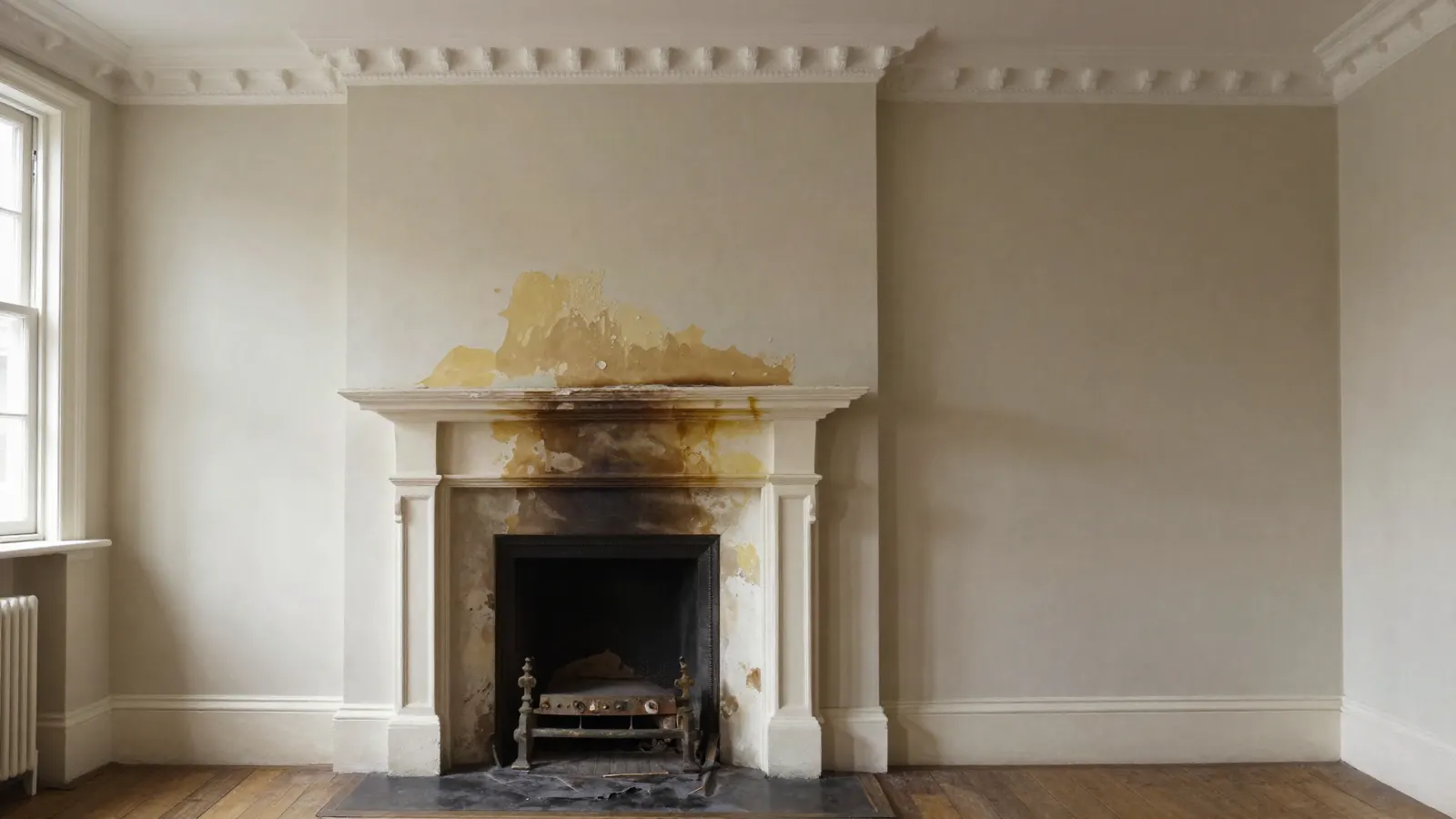
A damp patch on a chimney breast is one of the most common things we are called out to in Brighton and Hove. You see it most in the Victorian and Regency terraces, where nearly every room once had a coal fire and most of those fireplaces have since been boarded up. It may look like a grey damp patch, bubbling paint, or a brown or yellow, tar-like stain that keeps coming back through every coat of emulsion.
The good news is that it is almost never rising damp, and it rarely needs a chemical damp proof course. Chimney breast damp nearly always comes from the chimney itself. Once you know which of a handful of causes you have, the fix is usually straightforward.
Why chimney breasts get damp
There are four usual causes, and old chimneys often have more than one at once.
1. Rain getting in at the stack
Chimneys are among the most exposed parts of any building. The Society for the Protection of Ancient Buildings (SPAB) points out that a single displaced tile, a defective lead flashing or a cracked mortar fillet can let in enough water to do real damage. Look out for:
- Flashing. The lead where the stack meets the roof slopes. Lifted, split or missing lead is a classic leak point.
- Flaunching. The sloped mortar bed holding the pots on top of the stack. Once it cracks, water runs straight into the brickwork and the pots work loose.
- Pointing and brickwork. Washed-out joints on a stack that has faced decades of salty, wind-driven rain off the Channel.
- Uncapped pots. An open pot on a disused flue lets rain fall straight down the chimney.
Rain-driven damp usually shows as a well-defined patch that appears or spreads after wet weather. You will often see it in the top-floor room or loft, closest to the stack.
2. Condensation inside a sealed-up flue
This is the cause we see most after a renovation. When a fireplace is bricked or boarded up and the pot is capped solid, the flue becomes a sealed tube of cold masonry. Warm, moist air still gets into it and condenses on the cold brickwork, with nowhere to go. SPAB's guidance is blunt: dampness on chimney breasts is often caused by condensation within the flue, and disused flues suffer from it when they are closed off without ventilation at the top and bottom.
3. Salts left behind by coal fires
A century of burning coal leaves deposits inside the flue. Some of those salts, mainly chlorides and nitrates, are hygroscopic. That means they absorb moisture from the air whenever it is humid. SPAB notes that these salts remain long after a flue has stopped being used, and cause damp patches on the plaster around the breast.
The tell-tale sign is damp that comes and goes with the weather. It is worse on muggy, humid days, and it does not follow rainfall. The salts can even pull moisture from the air of the room itself.
4. Tar staining carried through the plaster
The brown, yellow or orange stains that look like tea or tobacco are tar and soot deposits. Moisture in the flue dissolves them and carries them through the brickwork into your plaster and wallpaper. Without moisture, they would stay put. So a tar stain is a symptom: it tells you that one of the causes above is moving water through the breast. Painting over it does not work. The stain bleeds back through within weeks.
A brown stain on a chimney breast is not the problem; it is the evidence. Find out what is wetting the flue and the staining stops.
How to tell which one you have
| What you notice | Most likely cause |
|---|---|
| Patch appears or grows after heavy rain | Rain at the stack: flashing, flaunching, pointing or an open pot |
| Damp comes and goes with muggy or humid weather, regardless of rain | Hygroscopic salts in the old plaster and brickwork |
| Breast went damp after the fireplace was blocked up | Condensation in an unventilated flue |
| Brown, yellow or tar-coloured staining | Tar deposits being carried through by moisture (any of the above) |
| White, fluffy crystals on the surface | Efflorescence, a sign water has passed through |
| Damp only at the bottom, at skirting height, on the ground floor | Possibly ground moisture, so check the wall generally, not just the chimney |
Two cautions. First, condensation in a flue is often worse in rainy weather simply because the air is more humid. So "it gets worse when it rains" does not automatically prove a roof leak. Second, staining tends to show most on upper floors and in rooms just below the stack, but that is a tendency, not a rule.
Terraced houses and shared stacks
In a Brighton terrace, your chimney stack is very likely shared with next door. Each flue is separated from its neighbour by a thin brick divider. Over time the acidic deposits in old flues attack that brickwork and the lime lining (the parging), so air and moisture can pass between flues. If your breast is damp and your own chimney looks sound, it is worth checking what the stack is like on your neighbour's side, and whether their flue is in use or sealed. Because the stack is shared, repairs at roof level may also need a conversation with them, or a notice under the Party Wall etc. Act 1996.
How to fix a damp chimney breast
Work from the top down and the outside in. Replastering comes last.
Fix the stack
Get the chimney inspected, ideally with photos from a drone, a roofer's ladder or a scaffold. Repair any lifted or split lead flashing, re-bed cracked flaunching, and repoint open joints. On an exposed stack, renewing the flashing properly with lead soakers is often the single biggest improvement.
Cap disused pots, but keep them ventilated
Disused flues need protecting from rain and ventilating. SPAB's advice is that redundant chimneys should be ventilated at the top and the bottom. Historic Environment Scotland recommends a ventilated cover on unused pots, such as a galvanised conical cap with bird mesh. It warns that solid ceramic caps restrict ventilation and should not be used where a flue already shows signs of damp. The Solid Fuel Association also advises capping in a way that can be undone if you ever want the fire back.
As a guide, a ventilated cowl or cap typically costs from around £100 to £215 supplied and fitted. Scaffolding adds roughly £150 to £300 if the stack cannot be reached safely without it (MyJobQuote, October 2026).
Keep a vent at the bottom
If the fireplace is blocked up, fit a vent grille in the board or brickwork. Air should flow up through the flue and out of the ventilated cap at the top, carrying moisture with it. A blocked fireplace with no vent and a solid cap is the textbook recipe for a damp, stained breast. Never stuff a flue with insulation, newspaper or a sealed chimney balloon and leave it there permanently. Fully sealing it is exactly what causes the condensation in the first place.
Line a working flue
If you still burn wood or use a stove, condensation staining is usually solved with a proper flue liner suited to the appliance, fitted by a registered installer. That is a different job from a disused flue.
Then deal with the plaster
Once the source is fixed, the plaster on the breast is usually still full of salts and tar. Replastering over a wet, salty wall is a waste of money: SPAB warns that new plaster put on before the wall has dried is likely to be contaminated by the salts still in it. So:
- Give it time to dry. A common rule of thumb is about a month for every 25mm of wall thickness. A chimney breast is thick masonry, so expect months rather than weeks.
- Remove the contaminated plaster back to the brick across the stained area and a margin around it.
- Replaster with the right system for the building. On older and listed buildings, breathable lime plaster is usually the right choice. SPAB itself is sceptical of salt-resistant plasters, which it says can disguise damp rather than cure it. Where the source has been fixed and the breast is heavily salted, a salt-resistant renovating plaster is another option. We explain the thinking in why we strip walls back to brick.
What does not work on its own: stain-block paint over tar stains (it may hide the colour for a while, but it does nothing about salts or moisture), gypsum skim over old plaster, or a chemical damp proof course. There is no reason to inject a DPC into a chimney breast whose damp is coming from above.
What about removing the chimney breast?
Some owners decide to remove the breast altogether. That is a structural job, not a damp fix. It needs a Building Regulations application. In a terrace the breast is usually built into a party wall, so the Party Wall etc. Act 1996 is likely to apply. Whatever is left above must be properly supported, with a steel beam or, where the council accepts them, gallows brackets. Rules on supporting the remaining stack vary between councils, so check with Brighton & Hove Building Control before anyone picks up a hammer. If the stack stays on the roof, it still needs a ventilated cap and an air brick lower down.
Getting it diagnosed properly
Chimney breast damp is easy to misdiagnose. A moisture meter will read high on salty plaster even when the wall is dry, and a stain can be old, from a leak that was fixed years ago. A proper damp survey looks at the stack, the flue, the ventilation and the plaster together, and tells you which of the causes you are dealing with. For damp elsewhere in the room, see our guides to penetrating damp and condensation vs damp.
Chimney breast damp in Brighton and Hove?
We survey and repair damp chimney breasts across Brighton, Hove and Sussex. We will tell you honestly whether it needs a roofer, a cap and a vent, or replastering, and we will not sell you a damp proof course you do not need. Surveys start from £95 plus VAT, credited against any works. As a Biokil-approved contractor, our qualifying damp proofing work carries a 30-year guarantee. Call 01273 536 985 or get in touch.