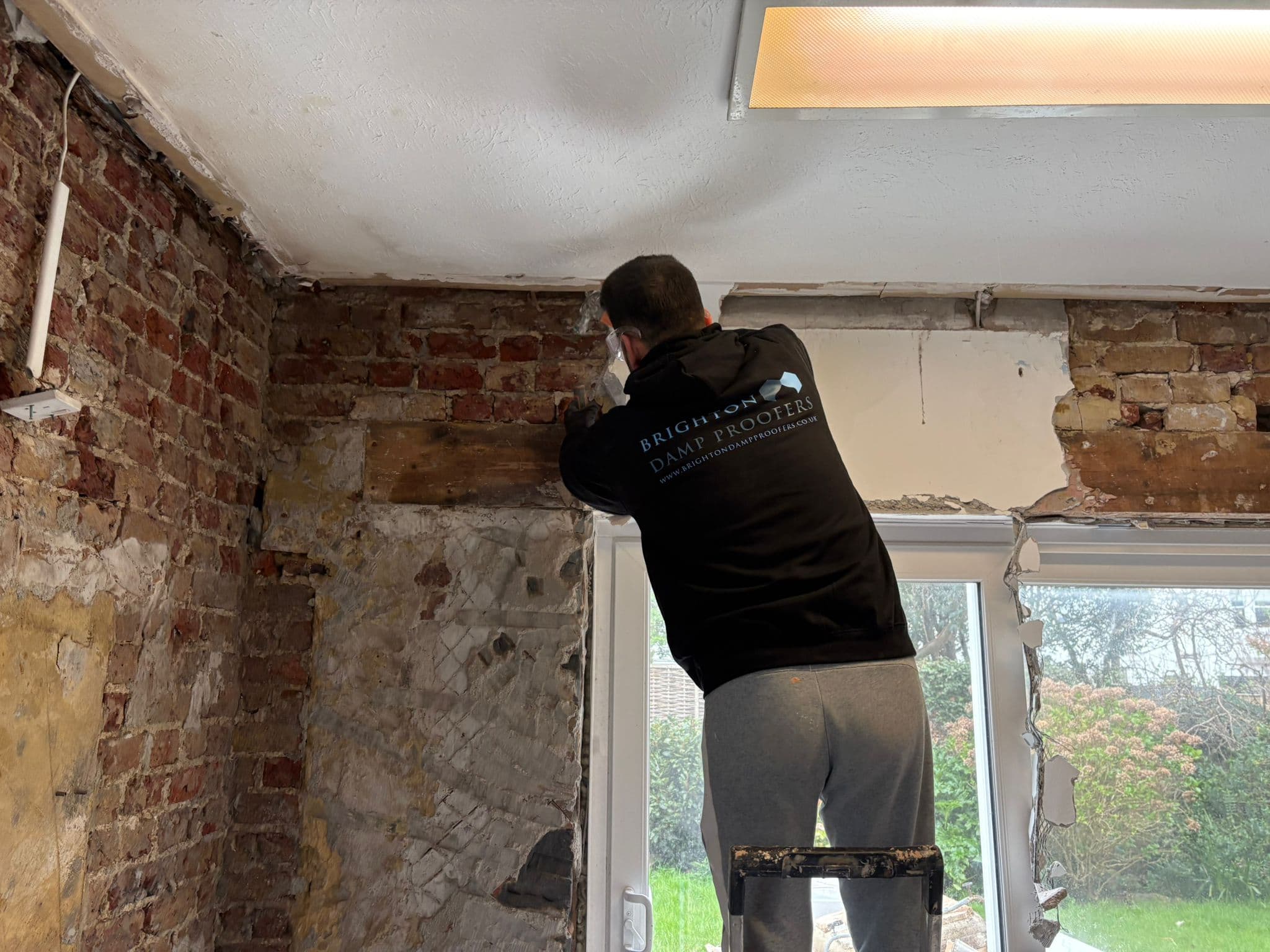
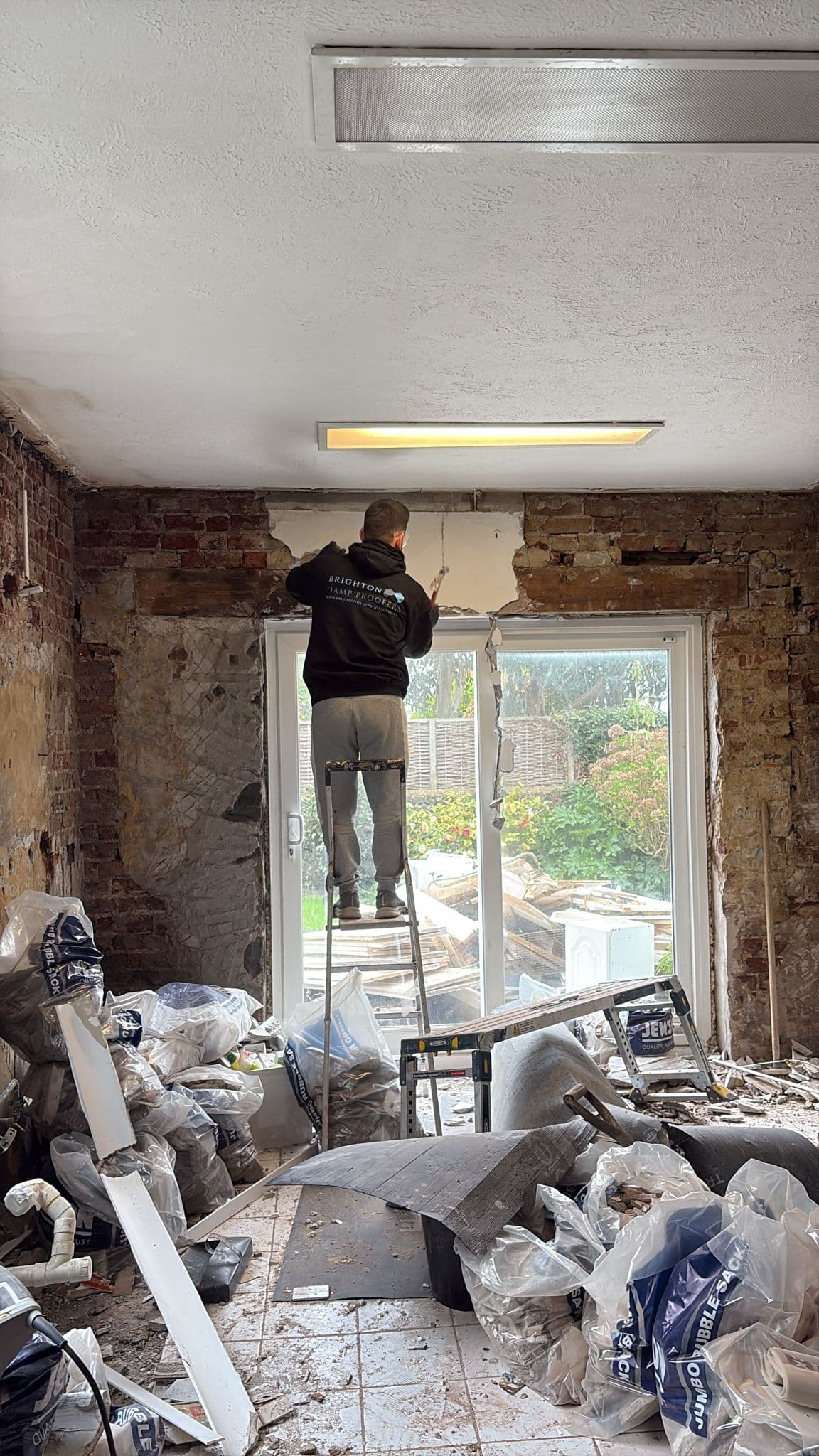
When people picture damp proofing, they usually picture the cure — an injected damp-proof course, a membrane, a treatment. What they rarely picture is the hacking off: a Brighton Damp Proofers team taking a room back to bare brick, filling rubble sacks, exposing 120-year-old masonry. Yet that messy stage is often what decides whether a damp repair holds for decades or fails within a winter.
Here is why we almost always strip damp walls right back before a single trowel of new plaster goes on.
The plaster is part of the problem
Years of rising damp do not just wet your plaster — they change it. As ground water travels up through a wall, it carries dissolved nitrate and chloride salts with it. The water eventually evaporates at the wall surface, but the salts cannot evaporate, so they stay behind, building up in the plaster over time.
Those salts are hygroscopic: they actively attract and hold moisture from the air. That is the crucial bit. Even after a new damp-proof course has completely stopped water rising through the masonry, salt-laden plaster will keep pulling dampness out of the room's humidity. The result is a wall that looks freshly done for a few weeks, then starts to show the same tide marks, blown patches and peeling paint all over again. Skim over the old plaster and you have buried the actual problem behind a thin coat of new gypsum.
Why we go back to bare masonry
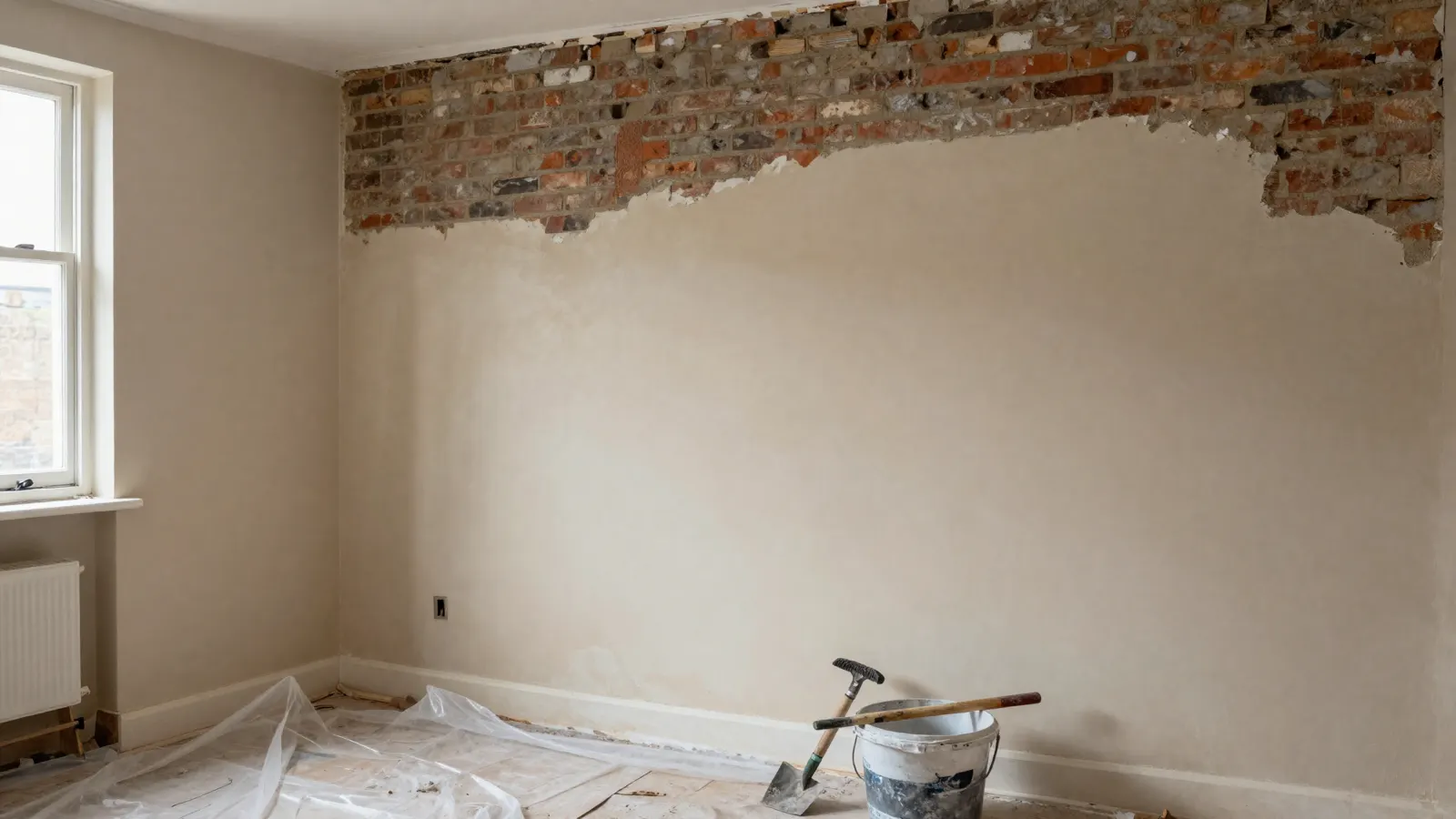
The only reliable fix is to remove the contaminated material entirely. We hack the old plaster off back to bare brick or stone — typically to at least a metre above the highest sign of damp, and often full height where contamination is severe — and take out skirtings and anything else holding moisture against the wall.
It is dusty, disruptive work, but it does two things nothing else can: it gets rid of the salt reservoir for good, and it lets our surveyor read the wall properly.
What stripping out reveals
Behind a smooth painted wall, a lot hides. Once a wall is open we routinely find the real story:
- a failed or bridged damp-proof course that no surface treatment would ever have reached;
- decayed timber — old embedded plaster battens, bearing ends of joists or lintels softened by years of moisture, which then need timber treatment;
- raised external ground or a rendered-over airbrick bridging the original DPC;
- and the true extent of salt damage, which is almost always greater than it looked from the painted face.
You cannot specify the right repair for a wall you cannot see. Stripping out turns guesswork into a proper diagnosis.
Replastering so it actually lasts
With the wall bare and the cause treated, replastering is done as a system, not an afterthought. Depending on the property we use a salt-retardant renovating render that resists any residual salts, building it up in coats with mesh reinforcement where needed for a flat, durable finish. On older and listed buildings we switch to breathable lime so the wall can still manage moisture — the approach we explain in our guide to damp proofing listed buildings.
Done this way, the new finish is not just hiding a wall — it is part of the repair, designed to stay dry and stable for the long term.
If a quote for damp treatment does not mention removing the old plaster, be very careful. A new damp-proof course with the salt-contaminated plaster left in place is a repair that is designed to come back.
This is also why a cheap "skim it over" job often costs more in the end — you pay twice, because the wall has to be stripped and redone properly anyway. We would rather do it once. We carry out damp surveys across Brighton, Hove and Sussex from £95 plus VAT, credited against any works, and as a Biokil-approved contractor our remedial work carries a 30-year guarantee. Call 01273 536 985 or get in touch to book yours.