"How long will it take?" is usually the second question we are asked, right after "how much will it cost?" — and it deserves a straighter answer than it usually gets.
Here it is: damp proofing runs on two clocks. The first clock is the work — the survey, the treatment, the replastering. That is measured in days. The second clock is the wall itself drying out underneath, and that is measured in months. A company that only mentions the first clock is setting you up for a fright six weeks later when a patch of dampness reappears on a wall you have just paid to fix — even though nothing has actually gone wrong.
So let us walk through the whole timeline honestly, stage by stage.
Stage 1: the survey — an hour or two, report within the week
A proper damp survey of a typical house takes around one to two hours on site — longer for a large, older or more complicated property. The surveyor traces where the moisture is actually coming from, which matters more than anything that follows: treat the wrong cause and every other timescale on this page is wasted. (We wrote separately about what a damp survey involves.)
You should then expect a written report with findings and a fixed quote within a few working days — allow up to a week. Beware of any "survey" that ends with a contract on the kitchen table the same afternoon.
Stage 2: the treatment itself — usually one to two days
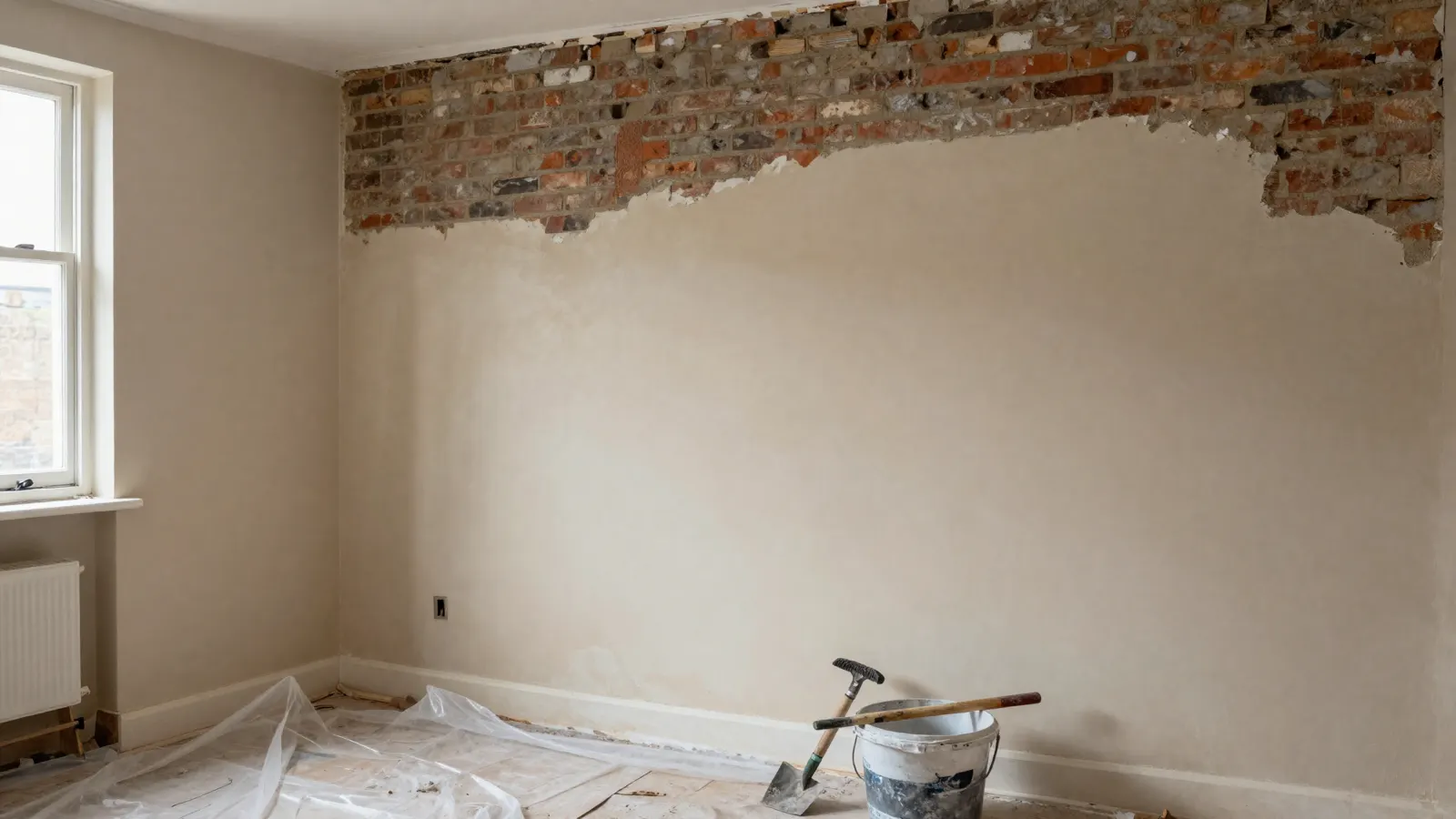
For genuine rising damp treated with a chemical injection damp-proof course, the on-site work for an average terraced house takes about one to two days. That includes hacking the old, salt-contaminated plaster off the affected walls, drilling a line of holes along the mortar bed joint, and injecting the damp-proofing cream that cures into a water-repellent barrier within the wall.
Other jobs run to different clocks, for comparison:
- Condensation and mould — a positive input ventilation unit is typically installed in a couple of hours, and condensation measures are often a same-day visit, with improvement over the following days and weeks.
- Woodworm and timber treatment — typically one to two days for a whole property.
- Penetrating damp repairs — a gutter fix is a day; repointing or patch rendering a few days; a full rendered elevation up to a week.
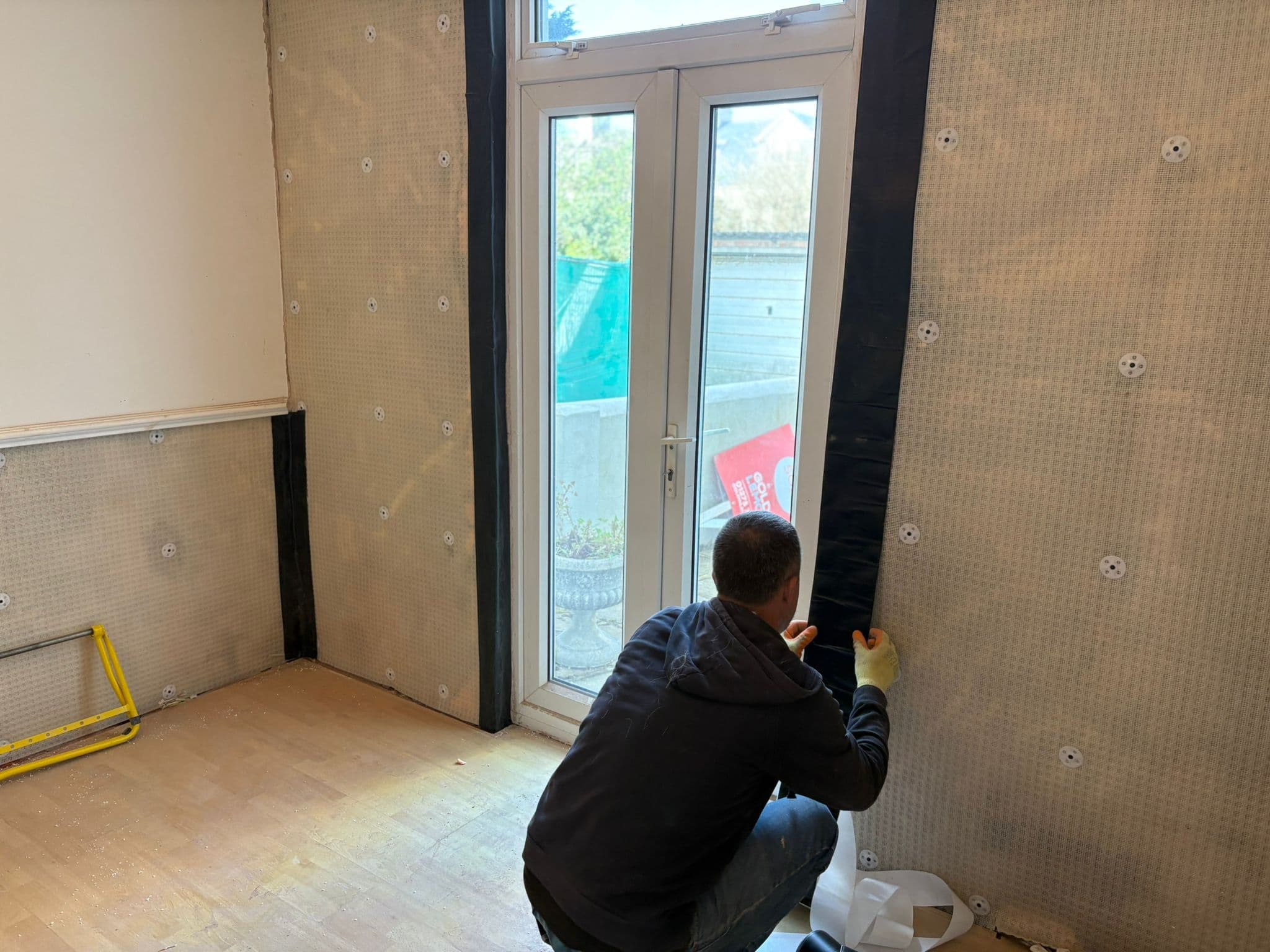
- Basement waterproofing with a cavity drain membrane — usually one to two weeks for a cellar, longer for a full conversion. (Here is how a cavity drain membrane works.)
Stage 3: replastering — from about two weeks after injection
Here is something that surprises people: after a chemical DPC, we do not wait for the wall to dry before replastering. That would mean living with bare brick for the best part of a year.
Instead, the industry-standard approach is to wait a short period after injection — product certificates specify at least 14 days — and then replaster with a salt-resistant renovation plaster applied while the wall is still damp. That is not a shortcut; it is the design. The specialist plaster's whole job is to stop residual moisture and hygroscopic salts from reaching your decorated surface while the wall dries out behind it. The replastering itself is a few days' work, and this is also why we strip walls back to brick rather than skimming over the problem.
Stage 4: the drying clock — six to twelve months, honestly
Now the second clock, the one the glossy adverts skip.
A wall that has been damp for years holds a serious amount of water, and once the source is stopped it dries at a fairly predictable rate. The long-standing rule of thumb from the Building Research Establishment (BRE Digest 163, "Drying out buildings") is about one month of drying for every 25mm of wall thickness. A standard 230mm (nine-inch) solid brick wall — which describes a great deal of Brighton's Victorian housing stock — therefore takes around nine months to dry fully. The industry code of practice puts it plainly: walls take at least six to twelve months to dry out, and impermeable paints or renders extend that further.
During those months the room is perfectly usable. The renovation plaster is doing its job, the skirting is back on, the furniture is back in. The wall is simply finishing the process quietly in the background.
Stage 5: decoration — breathable paint soon, wallpaper later
Fresh plaster needs a couple of weeks or so before it will take paint at all. From around four weeks you can decorate with a breathable, non-vinyl emulsion as a temporary finish. What you should not do is hang wallpaper or apply vinyl-based paint for around twelve months (longer on very thick walls), because impermeable finishes trap the residual moisture that is still working its way out and stop the wall breathing.
So the honest decorating answer is: painted and presentable within a month or two; final wallpaper-and-gloss finish after the wall has fully dried.
Can you live in the house while it is done?
Usually, yes. For a typical one-or-two-room rising damp treatment the work is done room by room: furniture and floor coverings are moved clear, skirting boards come off (salt-contaminated skirtings are replaced rather than refitted), and there is drilling noise and dust for a day or two while the plaster comes off and the holes go in. It is disruptive in the way any building work is disruptive, but you do not need to move out. Larger basement waterproofing projects are a bigger undertaking, and we will tell you honestly at survey stage what living through it will look like.
How long does it last once it is done?
A correctly installed chemical damp-proof course is a long-term fix — industry guarantees typically run 20 to 30 years. As a Biokil-approved contractor, our remedial work carries a 30-year written guarantee, which also matters if you ever sell: a documented, guaranteed repair is exactly what a buyer's surveyor and mortgage lender want to see.
Before any of this: make sure you actually need it
A word of honesty that is rare in this trade. The Royal Institution of Chartered Surveyors warns that rising damp is often misdiagnosed, that failure of an original damp-proof course is "extremely rare", and that nobody should diagnose the source of dampness with a moisture meter alone. A great deal of "rising damp" turns out to be condensation, penetrating damp, or a simple bridging fault — raised ground levels, a blocked cavity, a rendered-over airbrick — none of which needs an injected DPC at all, and most of which is fixed faster and cheaper.
That is why every timeline on this page starts with a proper diagnosis rather than a treatment brochure.
The work takes days. The drying takes months. The diagnosis is what decides whether any of it was worth doing — so get that right first.
If you want a real timeline for your own property rather than a generic one, that starts with a survey. We carry out damp surveys across Brighton, Hove and Sussex from £95 plus VAT, credited against any works, and as a Biokil-approved contractor our remedial work carries a 30-year guarantee. Call 01273 536 985 or get in touch and we will tell you exactly what needs doing, how long it will take — and whether it needs doing at all. For the money side, see our damp proofing cost guide.